
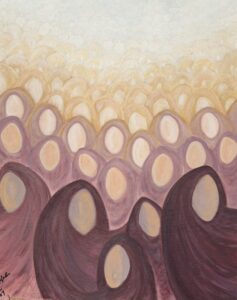
In a story inspired in part by disturbing Ottawa headlines, Burning Passions Theatre premieres a new play, Daughters of Khadija, November 28 and 29 at Saint Paul University Amphitheatre (223 Main Street, Ottawa). Written and directed by Ottawa theatre artist Laurel Smith, it’s co-sponsored by the Ottawa Muslim Women’s Organization and supported in part by the Government of Canada.
Burning Passions Theatre is a professional theatre company known for producing the award-winning Classic Theatre Festival, as well as a recent trilogy of plays about Ottawa seniors.
“This play follows a group of Ottawa women – mothers, daughters, friends – as they navigate their daily lives, each clinging to their dreams while carrying the unwelcome weight of how others often unfairly view them,” says Smith. “This story is ultimately about finding the courage of one’s voice, overcoming obstacles, and living inside one’s hope.”
After a series of consultations to discuss community concerns, a diverse troupe of performers came together to develop, rehearse and perform the play.
 Troupe member Suzanne Ragheb’s painting, “Absence,” is the signature image for the production. “As a visibly Muslim Palestinian woman, my lived experience has taught me what it means to be judged before being known, overlooked before being given a chance, and to carry the quiet fear of being targeted simply for who I am,” explains Ragheb, an artist, community advocate, and architecture graduate. “I was drawn to this play because I wanted to help tell stories that statistics cannot capture and stereotypes cannot explain: the fears we carry, the opportunities we lose, the dignity we fight to preserve, and the resilience it takes to keep showing up in a world that does not always see us for who we are.”
Fellow performer, healthcare professional and emerging poet Jamilah Bah, states, “theatre offers a unique space where difficult realities can be explored openly, without judgment, and made accessible to audiences from all walks of life. Daughters of Khadija encourages us to challenge our perceptions, fosters meaningful conversations, and, above all, cultivates empathy, because sometimes, understanding another person’s reality begins simply with being willing to witness it.”
For Smith, putting together a group of first-time performers has been “a real joy. Seeing each actor come into their role has been exciting and rewarding. Writing the show has also been a wonderful journey. All families carry secrets. Suppressing them can be harmful. But how, why, and when we address them can prove liberating, lifting a weight and deepening our relationships.”
Another performer, Nadia Firoz, a veteran of international development, research, and community engagement work across Canada and South Asia, is currently completing a PhD focused on the experiences of Rohingya refugee women. “As someone who has spent years researching questions of identity, belonging, exclusion, and displacement, I was drawn to this play because it explores how easily our sense of safety and belonging can be shaken,” Firoz explains. “What I find particularly powerful about my character is her belief that if you work hard, live respectably, and avoid trouble, you will be safe. Yet life does not always work that way, especially when prejudice and fear shape how others see you.”
In early October, Ottawa Police announced it was “aware of threatening and hateful emails sent to Muslim Association of Canada schools and centres in Ottawa.” An attack on a Muslim woman riding an OC Transpo bus in 2025 drew national attention. While Heritage Minister Marc Miller remarked at the October 1 start of Islamic History Month that, “we must continue to confront the scourge of Islamophobia that affects Muslim communities across the country,” the United Nations Special Rapporteur on Racism, Ashwini K.P., recently released concerns about “high levels of Islamophobia in Canada and unacceptable rises in anti-Muslim hatred…fuelled by misinformation and disinformation, which also all too often leads to real-life violence. I heard harrowing accounts of attacks against mosques, vehicle attacks against Muslims, and violence directed toward Muslim women, including those of African descent, when they are wearing head scarves in public.”
Smith reminds audiences that Daughters of Khadija, “is a play about people, not politics, even though all of us are deeply impacted by what happens in the political arena. We love theatre because it builds empathy and understanding, reminding us of what it means to be human, to live in community, to recognize our commonality.”
Daughters of Khadija will run for four performances: November 28 and 29, both days at 1:30 pm and 7:30 pm, with pay-what-you-wish tickets available at bptheatre.ca and by calling 613-695-9330.